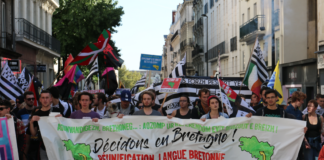
Definition of diversity
‘Diversity’ is a concept that is used more and more in our society. Nevertheless, what do we mean by ‘diversity’? Since there is no concrete definition of the term, we shall examine the positions and intentions, usually political, that lie behind the meaning of the word. First of all, we must make it clear that the term is misused in our country for political purposes. The concept is unrelated to its possible positive connotations, such as generosity, open-mindedness, kindness, intellectual wealth , etc. This misuse of the term aims to do harm to us Basques. For us, because of the way and the context in which it is used, the meaning it has been given and the cultural and sociological consequences it has, ‘diversity’ is a political concept. As for the context, the ‘diversity’ we refer to and denounce is a political tool used in colonial situations because, in a normalised state, the term is hardly used at all. Regarding the mode, it is used in a perverse way, as it is only an excuse to put one’s own culture on the same level as a foreign one, which is not done anywhere else in the world. With regard to the consequences, in our case, this use of the term ‘diversity’ means undervaluing Basque culture. Moreover, the meaning that the official and orthodox discourse gives to diversity often seeks to attack Basque-speakers. For instance, diversity in opposition to racism and those of us who defend our language and culture are denigrated, as if we were intolerant, cruel and lacking in morals. In face of this, we proclaim that, since it is a political issue, the one who is against the official version of diversity is no more cruel or intolerant, of greater or lesser morality, than the one who is in favour of the official version of diversity. As we have said, the concept of ‘diversity’ is used in situations of colonial domination, but for what purpose? Well, in our case, to divert the attention and the gaze of the population from the excesses of Spanish and French colonial policies, from trade union, political and judicial harassment of our language and, in general, to justify with moralistic positions the cruelties of the colonising process, seeking to neutralise our national discourse and to shame our self-conscious compatriots. However, we also defend cultural and linguistic diversity, but, as we shall explain below, with a vision of our own.
The linguistic diversity of the colonisers and the colonised
Is ‘diversity’ the same in all social and political contexts around the world? Is it the same in Tibet as it is in China? Do occupied and colonised peoples interpret diversity in the same way? Back here, in the Basque Country, the hegemonic forces, indigenous and foreign, have decided, in the name of diversity, that Spanish is as indigenous as Basque, for example. Have we Basques been asked what our opinion about this is? And if both languages were equal, both autochthonous, shouldn’t this equality be reflected in laws and in political, trade union, administrative and judicial spheres? However, Article 3 of the Spanish Constitution states that knowledge of the Spanish language is compulsory, and thus Spanish is protected in every way. Nonetheless, the Basque language, which is ‘co-official’, is not, in practice, recognised as co-official. Basque is constantly under attack from political and judicial institutions, day in and day out. Therefore, the word ‘diversity’ is only a conceptual tool to justify ethnocide. At first, they tell us that all languages belong to us and then they establish asymmetries, hierarchies and categories between languages and cultures: at the top of the totem pole, the Spanish and French languages and cultures, and at the very bottom, the Basque language and culture, which is fighting for its sheer survival.
The diversity of immigration
The Basque Country has long gone through successive waves of migration, stimulated by the insatiable greed of the Basque oligarchy in search of a cheap labour force. Moreover, this was done with the pretext of improving ‘our’ economy. These waves, as happened in previous centuries, made the already difficult situation of the Basque language and culture even more dire, although they were not the only agents of this difficult situation. The phenomenon of migration occurs all over the world, but its consequences are not the same in a sovereign state or in a colony, as the colony has no administrative mechanisms or resources to regulate and manage these migratory waves. Moreover, managing these migratory waves is very difficult when, in addition to there being economic objectives, there are also colonial cultural and political objectives.
In the Basque Country, there has always been a certain kind of messianism or missionary zeal regarding our language. We also see this in the treatment of immigration; here it is quite normal to hear that the languages and cultures of immigrants must also be integrated into our own. We once heard such talk at a sociolinguistics seminar in Donostia: ‘The languages and cultures of immigrants must also be taught in our schools, because they are citizens just as much as we are’. Where has it ever been seen that immigration culture has to be put on the same level as indigenous culture? Is there any example of this in the world? No, nowhere at all. Thus, we do not agree with this use of the concept of diversity, and we would like to denounce that, behind it all, there is a perverse intention to destroy our own culture and language.
Diversity and hegemonic culture
Should the political principle of diversity be interpreted equally in the social and political context of a strong, independent state and that of a small, colonised nation, struggling for survival? Does it have to be interpreted in the same way in Beijing and in Tibet? In Ankara and in Kurdistan? In Morocco and in Western Sahara? In Spain, and in Euskal Herria or in Catalonia? Indeed, should we value the concept of diversity equally in the case of a colony that tries to maintain its identity and, in the case of a colonial force, one that strives to keep it subdued and under threat of annihilation? Do those who justify and uphold colonisation and those who somehow oppose this asymmetrical situation have the same moral value? Would a Spaniard or a Frenchman think the same if the German or Russian army were to impose their language and culture on Spanish or French territory by force? Certainly not. Therefore, we do not accept the perverse use of the concept of diversity as it seems to be false in our case. There are no multilingual or multicultural societies in the world. In states that have several languages, Switzerland for example, there is no linguistic diversity because all of the territories that make up Switzerland are, in practice, monolingual. As for the moral value of diversity, we insist that we do not accept its moral character because it is a political tool to be used against a colonised people.
What kind of cultural diversity do we defend?
We stand for diversity in a global context: i.e. we strongly believe in defending local languages and cultures in the face of unfettered globalisation. When we go to Wales, for example, we want to hear Welsh in the street. The same goes with Galician in Galicia or Maori in New Zealand. In face of a kind of globalisation that seeks to push for a single, one-size-fits-all language and culture (English and Anglo-Saxon culture, respectively), we champion diversity on a global level.
We also take a clear stand in favour of local minority languages. The oppression that our language –and its speakers– have suffered over the centuries leads us to empathize with the struggle for the world’s minority languages, as solidarity between oppressed nations is a natural tendency that is not written down anywhere, but it does arise spontaneously.
This tendency explains, for example, why we want the Berber or Amazigh language and culture to be respected in Morocco. However, this does not mean that the Berber who comes to the Basque Country has the right to live in our oppressed nation as he would live in his own country. The Berber or Amazigh language should be defended in Morocco, not in the Basque Country. As we Basques have serious problems living in our language in the Basque Country, it would be suicidal to put our language on the same level as the languages of those who have just arrived here, as suggested by the ill-thought-out discourse of the local virtue-signalers. In our opinion, in the Basque Country, the Basque language must be the nexus between all diversities.
Therefore, praise for cultural diversity can be made on two different levels: on the one hand, one can praise cultural diversity on a global level, when one defends all of the cultures of the world, local cultures and those that are under threat by Anglo-Saxon globalisation; at that level, the defence of cultural diversity is absolutely positive and necessary. Another case is the position of certain groups in the Basque Country which praise the cultures of all those who have come here and aim to insert these cultures into our country, forgetting that our own language and culture are being oppressed and under threat. Praising cultural diversity on this level weakens our language and culture even more, because, as we have commented on other occasions, it relegates us Basque speakers to being a mere subgroup in our own land. That is why we cannot accept the defence of multiculturalism from this point of view.
Consequently, the true defence of multiculturalism, which we must champion, is based on the defence of local languages and cultures of the Peoples where it is the local language. Let Arabic be spoken in Arab towns and villages, Romanian in Romania, Amazigh in Morocco or Algeria, Quechua in Peru or Bolivia…. and Basque in the Basque Country. This is because the greatest contribution we Basques can make to the cultural diversity of the world is having a Basque Country that speaks the Basque language. Simply that.