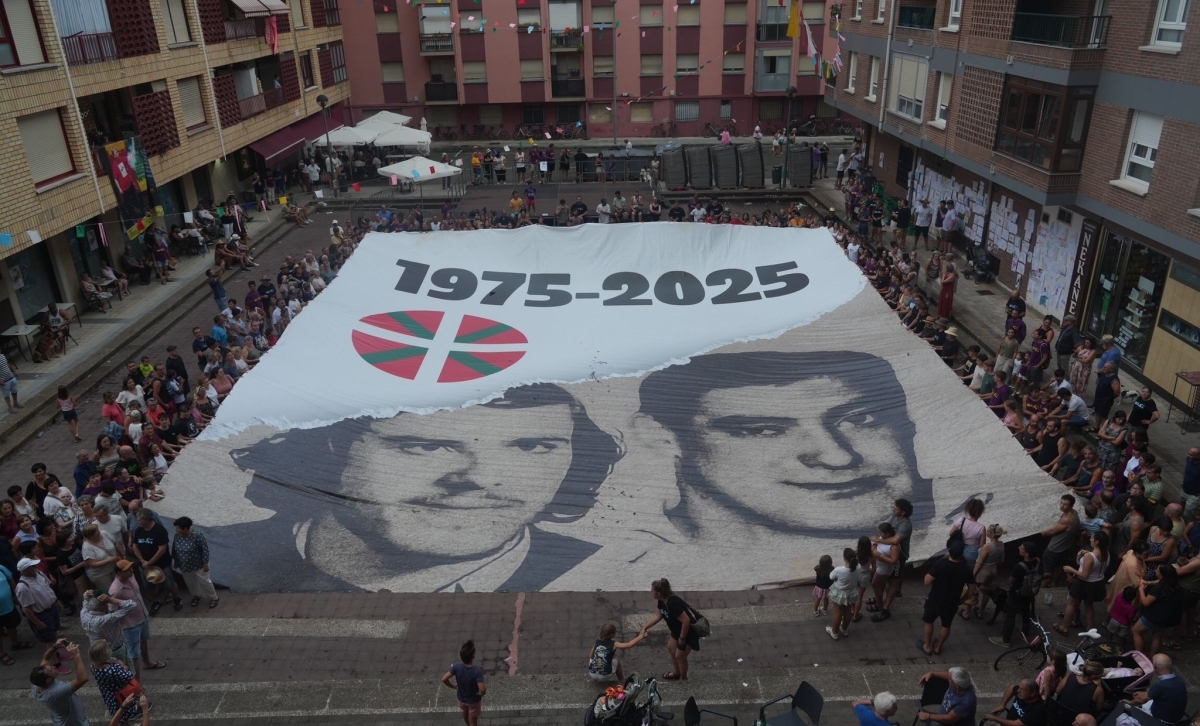
Note to our international readers: Txiki and Otaegi were two members of ETA executed in 1975 by Franco’s fascist regime, a few months before the Dictator’s death.
Fifty years have passed since Txiki and Otaegi were executed by Franco’s fascist regime. On this very special anniversary, tributes to the two Basque militants are proliferating throughout the Basque Country, and some things have been said that cause us concern and indignation. It is clear that political groups of different stripes have made partisan use of the figures of Txiki and Otaegi, claiming to represent these two Basque nationalists and grossly manipulating their political careers. This is truly regrettable.
Engaging in genuine historical revisionism (very fashionable nowadays), for example, a group here from the far left, which denounces the oppression of the working class but does not see the oppression of the Basque nation, has called the two Basque militants murdered by Franco’s regime “anti-fascist fighters.” We disagree. Txiki and Otaegi, like most ETA members at the time, were not merely anti-Franco militants, but also fighters for the independence of the Basque Country. Enthusiastic patriots. Before being executed in the cemetery of Cerdanyola, in front of his executioners and with rifles pointed at him, Txiki shouted “Gora Euskadi askatuta. Aberria ala hil!” (“Long live a free Basque Country. Homeland or death!”) before dying. The young man from Zarautz knew exactly why and what he was fighting for: against Franco’s fascist regime and for a free Basque Country. Two different goals, unrelated to each other. In fact, Franco’s regime soon disappeared, but our homeland has not yet achieved its freedom.
On the other hand, the terrible historical memory of some leaders of the Basque nationalist left is worrying. Some of them have also placed the careers of Txiki and Otaegi in the context of the “anti-Franco struggle,” forgetting their Basque nationalist and pro-independence leanings. Felipe González, Alfonso Guerra, Enrique Múgica, and Fernando Savater were also anti-Franco at that time. Should we place Txiki and Otaegi in the same camp? No, not at all. We insist that the two Basque activists murdered by Spanish fascism fought for the subjugated and oppressed (during Franco’s regime and now) Basque nation. They fought for the independence of Euskal Herria. Concealing this fact or failing to explain it adequately can only be understood from a Spanish unionist mindset, that is, from a purely Spanish nationalist perspective that denies the national oppression of the Basque Country.
Many thousands of Basque patriots suffered repression, imprisonment, and death during the dark days of Franco’s dictatorship. They all dreamed of a free Basque nation, like Txiki and Otaegi. Ignoring their nationalist dimension is an act of unjustifiable historical revisionism, which we will denounce emphatically.
However, not everything that has been said on the occasion of the 50th anniversary has been untrue. Because there have also been many on the Basque nationalist left who have placed the struggle of Txiki and Otaegi within the parameters of national liberation. We all know that Franco’s obsession was to make the Basque Country disappear, and that in his political last testament he gave orders for that to happen. He left everything very well tied up. What has happened since 1975 confirms this: the Spanish political framework that we rejected in 1978, which denies our national identity and our right to self-determination, has been imposed on us Basques by force. Txiki and Otaegi’s dream, therefore, has not yet been fulfilled.