
As our readers know, at NAZIOGINTZA we closely follow current events in other minoritised nations in Europe. Thanks to our network of contacts, we gather political and cultural news from these nations, which is a good indicator of their national dynamism. Obviously, the degree of national consciousness and demands for sovereignty is not the same in all stateless nations in Europe. Some of them have strong pro-independence movements, a high degree of national awareness and a robust language of their own, while in others the processes of assimilation and colonisation are very advanced, national consciousness is weak, their own language is marginalised and, at best, there is only a weak regional awareness.
Nations are not static political entities, but dynamic ones. The processes of nation-building and strengthening national awareness are also dynamic. Undoubtedly, the vicissitudes of history largely determine the political situation of minority nations and the extent of their national aspirations. Nations that in the past posed serious territorial conflicts are currently in a phase of political lethargy (the Basque Country could be one of them), while nations that until recently posed no problem to their dominant states are now seeing the emergence of strong pro-independence movements. What is happening in Europe?
Two European independence movements attracted the attention of stateless nationalists across the continent in the 2010s: Scotland and Catalonia. In Scotland, the push for independence led to the 2014 referendum, which the independence supporters lost by a narrow margin (45% to 55%). In Catalonia, after several years of separatist fervour, in 2017 the Spanish state unleashed a wave of repression following the unauthorised referendum held on 1 October. This wave of repression nullified Catalonia’s autonomy, sent politicians and activists to prison (many others were forced into exile) and criminalised the Catalan pro-independence movement. The clumsy actions of the Catalan political class, which shied away from conflict with Spain and failed to secure independence in parliament, led to disillusionment among a large section of the population, and euphoria gave way to disappointment. Spanish unionism currently governs Catalonia.
At the same time that the national dynamics of Scotland and Catalonia entered a phase of ‘impasse’ (as did the Basque pro-independence movement, evolving towards more possibilist positions), in other stateless nations of Europe the independence movement emerged forcefully. Let us analyse these little known among us emerging pro-independence movements.
CORSICA: Corsican nationalism and the pro-independence movement have experienced an extraordinary surge in recent years, resulting in surprising electoral success. In the 1980s, French President François Mitterrand said this: “When Corsican nationalists achieve 15% representation, I will start worrying”. Mitterrand would be very concerned today, seeing that Corsican nationalists now have a 73% representation in the Corsican Assembly. The rise of the nationalist movement in Corsica has come since 2015, and today it holds an absolute majority in the island’s institutions. The independence movement is particularly strong among young people.
Corsica has demanded a new autonomy statute from France, with more political powers, recognition of Corsican national identity, co-official status for the Corsican language and legislative power. France does not seem willing to accept all these demands, but the proposal will soon be discussed in the French National Assembly.
To put the data on the nationalist vote in Corsica (73% representation in its local Assembly) into context, here is the nationalist vote in other nations under French administration: Northern Basque Country, 25%; Brittany: 5%; Alsace, 8%; Northern Catalonia, 5%; Occitania: 1%.
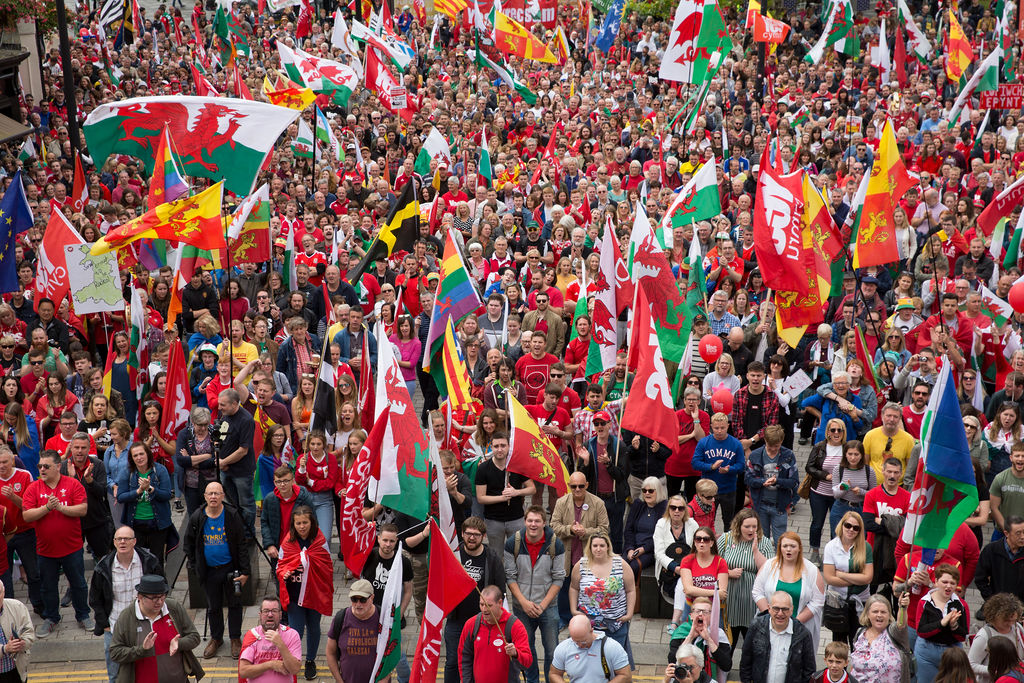
WALES: The Welsh pro-independence movement, until recently a minority, is expanding, and polls predict strong growth. Welsh nationalism, centred around the historic PLAID CYMRU party, has a 23% representation in the Welsh Parliament, and has remained so for many years. It has now evolved towards clearly pro-independence positions, spurred on by the Scottish independence process and by Brexit, which many Welsh people rejected. In 2016, the pro-independence movement YES CYMRU was created, a popular and cross-party organisation that unapologetically advocates for independence and is gaining widespread support in this Celtic nation.
Polls show growing support for independence in Wales (especially among young people), and in the recent by-election in Caerphilly, pro-independence parties doubled their previous results, winning 49% of the vote. The next Welsh Parliament elections will be held in May 2026 and will be an important test for the emerging Welsh independence movement.
FAROE ISLANDS: In this archipelago under Danish rule, pro-independence and unionist parties are on equal footing, with 50% each of the seats in parliament. The two blocs have failed to reach an agreement on a referendum on self-determination, plunging Faroese politics into a long impasse, a political deadlock with no political solution in sight. However, a crack has recently appeared in this prolonged stalemate, presenting an opportunity for change. In fact, this year, five political parties from the archipelago (three pro-independence and two unionist) signed an agreement in favour of self-determination and presented it to the Danish government, thus opening the door to a process of independence.
The Danish Government’s response remains to be seen. Although it has so far shown a very open and understanding attitude towards the Faroe Islands, in this unstable international context it could succumb to the temptation to possess a territory in the North Atlantic, ignoring the Faroe Islands’ desire for independence. We shall see.
QUEBEC: Outside Europe, Quebec nationalism is also enjoying a sweet moment, after many years of marked decline. The young leader of the historic PARTI QUEBECOIS, Paul Saint-Pierre Plamondon, with his clearly pro-independence rhetoric, is managing to significantly improve electoral expectations, according to the polls. Young people, in particular, are the segment of the population where support for independence is hegemonic. According to all polls, the PARTI QUEBECOIS will win comfortably in the next elections (autumn 2026) and could secure an absolute majority. Saint-Pierre Plamondon has promised that if he comes to power, he will call a third referendum on self-determination (the previous ones were in 1980 and 1995).
NAZIOGINTZA will soon publish an interview with the historic leader of the PARTI QUEBECOIS, Jean-Pierre Charbonneau, in which we will analyse in depth the current state of Quebec nationalism.
We will closely follow the evolution of the emerging independence movements in Corsica, Wales, the Faroe Islands and Quebec. If they consolidate, they could be an important catalyst for revitalising other European independence movements, including our own. We will never tire of repeating the importance of collaboration between nations fighting for their independence, the importance of creating common spaces where ideas, experiences and projects can be exchanged. For this reason, NAZIOGINTZA represents Euskal Herria in ICEC, the Brussels-based organisation that brings together some of the European nations pursuing self-determination (https://icec.ngo/).
We will also follow with interest, of course, the political developments in other European nations where the drive for independence is strong, although having recently entered a dormant phase. Catalonia, Scotland, Flanders and South Tyrol, for example, are interesting models for the Basque Country, nations with which we have many political similarities. We have no doubt that any new independence process that begins in Europe will have a contagious effect and activate local pro-independence movements. Hopefully we will see this soon.