
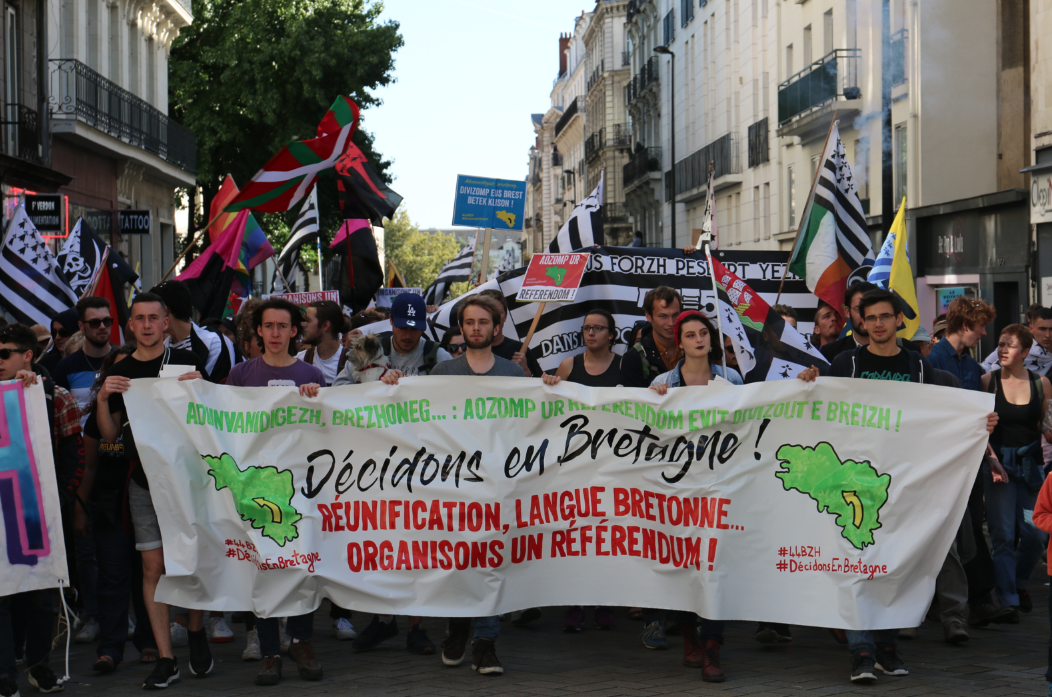
Like the Basque Country, Brittany is a divided nation. This Celtic nation has five departments (French regional municipalities): four of them are located in “official” Brittany, in the administrative region of Brittany, and the fifth (Loire-Atlantique, Liger-Atlantel, in Breton) is outside it, in another administrative region (in Pays de la Loire). Nantes (Naoned in Breton) is the capital of Loire-Atlantique (and of historic Brittany), and Rennes (Roazhon) is the capital of “official” Brittany, that of the four departments.
The division of Brittany took place in 1941, during World War II. It was established by the collaborationist Marshal Pétain for two reasons: on the one hand, to neutralize the strength that Breton nationalism was acquiring at the time; and on the other, because the oligarchy and upper bourgeoisie of the Loire-Atlantique asked him to do so. In fact, as Loire-Atlantique was the richest region in Brittany, the local oligarchs wanted to strengthen economic ties with the Pays de la Loire (and France), hoping that their interests would be enhanced by this integration. Needless to say, Pétain made his decision without consulting the Bretons.
Pétain’s decision was not overturned by the new members of the French government when World War II ended, and this artificial division of Brittany has been confirmed in all territorial organizations that have been established in France since then.
Nantes (Naoned) was the historic capital of Brittany, just as Pamplona (Iruñea) was that of the Basque Country. Both cities have special symbolic significance for Basque and Breton nationalists. Curiously, however, neither is part of the current official administrations of the Basque Country or Brittany.
The Bretons’ struggle for reunification is longstanding. Calls for a referendum on Breton unity have been constant over the last 30 years. This demand is widely supported: not only by Breton nationalist parties (which are in the minority in the Regional Council), but also by many deputies from both left-wing and right-wing French parties. In the Basque Country under Spanish rule, on the other hand, only Basque nationalist parties defend territorial unity, a demand that, unfortunately, is not widespread.
All surveys conducted in recent years show clearly that in both official Brittany and the Loire-Atlantique department, the majority of the population is in favour of reunification. The survey conducted in 2019 by the TMO Institute showed that 68% of citizens in the four departments of Brittany and 62% of those in Loire-Atlantique wanted the reunification of Brittany. Furthermore, in 2018, a massive signature collection campaign was also carried out in Loire-Atlantique, gathering 105,000 signatures to call for a referendum. The Loire-Atlantique Departmental Council forwarded the request for a referendum to French President Emmanuel Macron, but this request went unanswered. In 2021, the Nantes City Council (Loire-Atlantique) voted in favor of organizing a referendum on the unity of Brittany.
Finally, in 2023, 25 Breton Deputies in the French National Assembly presented a proposal to hold a referendum in the Loire-Atlantique department on the reunification of Brittany. Unfortunately, this initiative did not receive the necessary support in the French parliament and did not go ahead.
However, not everyone in the Loire-Atlantique department is in favor of Brittany’s union. NAZIOGINTZA asked the historic Breton patriot Gael Roblin, member of the nationalist organization War-Sav and councilor for the city of Guingamp-Gwengamp, about this. Roblin tells us that the right-wing parties in Loire-Atlantique are the ones that take the hardest line against reunification, representing the interests of the local oligarchy, Nicolas Sarkozy’s Les Republicains (LR) political party, in particular. As in Pétain’s time, these oligarchs prefer the Loire-Atlantique to remain within the Pays de la Loire. They also believe that a united Brittany would be a threat because it could reawaken Breton national awareness, which would be a disaster for French Jacobinism.
Although the situation of the Breton language and culture is precarious in all four departments of Brittany, it is worse in the department of Loire-Atlantique. In this respect, there are also similarities with the Basque Country under Spanish administration, with the situation in the Basque Autonomous Community and Navarre. Breton identity does not have institutional support in Loire-Atlantique, where the difficulties for organizations working for the Breton language are greater. Political representation in local institutions is also different: in the official Regional Council of Brittany, Breton nationalists have 7 deputies out of 83 (8.5%). They have no representation in the Departmental Council of Loire-Atlantique. However, they do have councilors in several towns in the department, including the capital, Nantes-Neonod.
The struggle for the reunification of Brittany continues. Gael Roblin is optimistic. But he speaks plainly: “Our goal goes far beyond Breton unification. Our goal is the independence of our nation.” Clearly, we Basques and Bretons share territorial problems and national ambitions, which should strengthen our relationship and open up new areas for collaboration.